UCSD CSE131 Syllabus and Logistics
- Joe Gibbs Politz (Instructor)
- OH: Tuesday 3pm and Wednesday 1pm, CSE 3206 (Joe's office)
- Shaurya Raswan (TA)
- OH: Mondays at 12PM, B275 CSE Basement or Zoom
Basics - Schedule - Staff & Resources - Grading - Policies
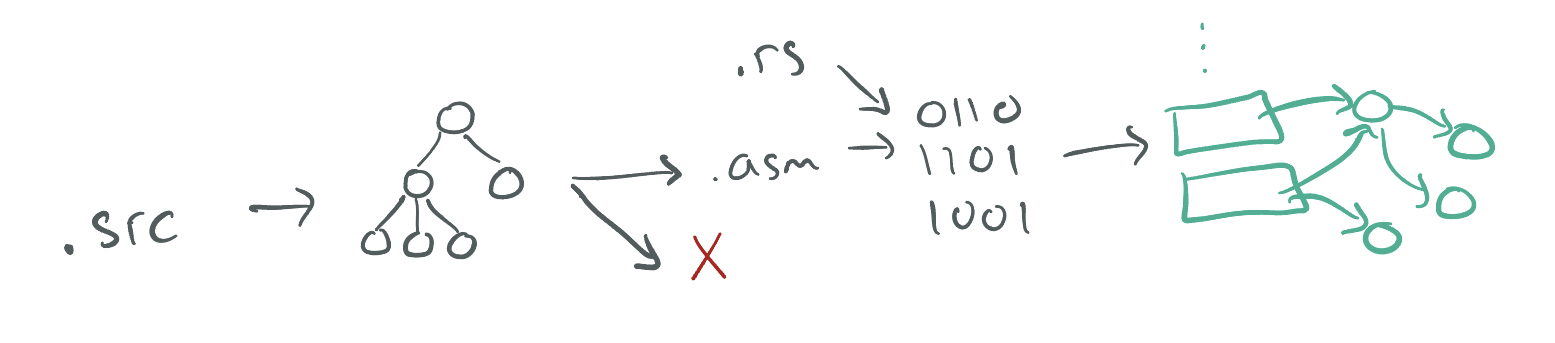
In this course, we'll explore the implementation of compilers: programs that transform source programs into other useful, executable forms. This will include understanding syntax and its structure, checking for and representing errors in programs, writing programs that generate code, and the interaction of generated code with a runtime system.
We will explore these topics interactively in lecure, you will implement an increasingly sophisticated series of compilers throughout the course to learn how different language features are compiled, and you will think through design challenges based on what you learn from implementation.
This web page serves as the main source of announcements and resources for the course, as well as the syllabus.
Basics
- Office Hours:
- Joe: Tuesday 3pm and Wednesday 1pm, CSE 3206 (Joe's office)
- Shaurya: Monday 12pm, also discussion Wednesday 12pm (CSE B275)
- Q&A Forum: Piazza
- Textbook/readings: There's no official textbook, but we will link to different online resources for you to read to supplement lecture. Versions of this course have been taught at several universities, so sometimes I'll link to those instructors' materials as well. Some useful resources are:
Schedule
The schedule below outlines topics, due dates, and links to assignments. The schedule of lecture topics might change slightly, but I post a general plan so you can know roughly where we are headed.
Week 7 –Optimizations and Types
- Wednesday Lecture Chalkboard
- Readings
Week 6 - Types, Towards Optimization
Week 5 - Code Reviews (no lecture)
Week 4 -Functions and Calling Conventions
- Wednesday Handout - Wednesday implemented; scroll to BOTTOM to see full copilot chat log
- Reading and Resources:
Week 3 –Binary Operators, Types, and the JIT
- Friday Handout Filled
- Wednesday Handout Filled
- Monday Handout Filled
- Max New on Conditionals
- Max New on Tagging
- Wikipedia on the AMD64 Calling Convention
Week 2 –Binary Operators, Types, and the JIT
- Friday Handout
- Wednesday Code
- Monday Code
- Max New on
let - Memory Representation of Values in Ocaml More discussion of a language with tagged value representations (and Ocaml is type-checked!).
- V8 Blog Post Including Number Representations This goes a little further than we are right now, but focus on the fact that V8, one of the widely deployed JS engines, uses tag bits for its numbers.
Week 1 - Rust and Source to Assembly Conversion
- Assignment 1
- Repository (includes PDF of handout)
- Friday Handout [Filled]
- Wednesday Handout [Filled]
- Monday Handout
- Reading and resources:
- Rust Book Chapters 1-6
- x86-64 quick reference (Stanford)
- x86-64 quick reference (Brown)
- Max New on Adder Max New and Ben Lerner have done a nice job writing up notes on some of my original scrawlings around this material. They don't use exactly the same style or make the same decisions I do in this class, so make sure you implement what's in our assignments, not what they wrote, but things are close enough to be useful.
Week 0 – Welcome
- Friday In-class Notes
- Friday repository
- Friday Handout
- Reading and resources:
Course Components and Grading
Your grade will be calculated from engagement, assignments, and code demos.
-
Assignments are given periodically, typically at one or two week intervals. On each you'll get a score from 0-4.
Assignments will have a mix of written work and programming work. The written work will include things like:
- describing and justifying design decisions you made in your compiler
- giving a description of implementation or tradeoffs in a potential design decision one could make
- doing code review of other students' compilers
We plan for 6 total assignments – this ended up being 7! There will be opportunities for later assignments to count towards credit for earlier assignments:
- The grade for Boa will be the max of HydraBoa's grade and Boa's grade
- The grade for Diamondback will be the max of Eastern Diamondback's grade and Diamondback's grade
- We managed to reach 7 assignments, but did not change the cutoffs, giving more ways to reach the grade thresholds for assignments
-
Code Demos are the exams for the course. Twice during the quarter you will meet in-person with the instructor and/or a TA for a code review of a recent assignment. You will demonstrate your code running on examples we provide in the code review and walk us through how your code works on those examples. We will assign a 0-4 score and will also give feedback on what you'd need to fix to raise your score. More details about the promps and scheduling will be shared in advance of the reviews.
In finals week, you will have a chance for a second round code review for one of your in-quarter code reviews, which can raise your score by up to 3 points (e.g. 0 to 3, 1 to 4, 2 to 4) on that review. In the second round review you will present your response to our feedback from the first review.
This is also the only policy for make-ups for a missed code review during the quarter: scheduling a second round review in finals week. A missed review has a maxiumum score of 3 for the rescheduled review. Missing both in-quarter reviews puts a C ceiling on your grade (if you miss one you can still earn an A).
The standards for grade levels are below. You must achieve the thresholds for all course elements to earn that letter grade.
- A:
- Code review point total 7 or 8 (including second round reviews)
- Assignment point total 20 or higher (update: out of 28)
- B:
- Exam point total 5 or 6 (including second round reviews)
- Assignment point total 16 or higher (update: out of 28)
- C
- Exam point total 3 or 4
- Assignment point total 12 or higher (update: out of 28)
+/- modifiers will be assigned around the boundaries of these categories consistently across students, and will also take into consideration participation in class and Piazza, as well as exceptional assignment or code review performance.
Policies
Programming, AI, and Collaboration
We encourage you to attempt all programming projects yourself first. They are meant to provide productive learning and to prepare you to present your understanding in code reviews.
Of course, there is lots of valuable learning you can get from discussing the assignments with us and with your peers, and we encourage it after you've made attempts yourself. When you work together with anyone (including course staff!), you should properly credit them. See the guidelines below for crediting other students you work with.
Though we discourage you using it as a way to get started, write entire functions, or set up your project, you're welcome to use AI tools to aid your programming. In particular, it may be useful for learning new Rust idioms or autocompleting “routine” parts of functions to save time. However, we both (a) from experience don't think that AI agents are very good at writing the core logic of the compilers in this class and (b) will be checking your understanding of the code you wrote in code reviews. So you should be able to understand, trace, debug, and update any code that you generate from an AI tool.
In each assignment:
- Any code that you didn't write must be cited in the CREDITS.txt file that
goes along with your submission, or in an inline comment next to the code you
didn't write.
- Example: On an open collaboration assignment, you and another student chat online about the solution, you figure out a particular helper method together. Put an inline comment next to the FOO method saying “This FOO method was developed in collaboration with Firstname Lastname”
- Example: On an open collaboration assignment, a student posts the compilation strategy they used to handle a type of expression you were struggling with. Your CREDITS.txt could say “I used the code from the forum post at [link]”
- Example: If a function or a substantial logical chunk of code was generated by ChatGPT, Copilot, or another LLM or AI system you could put an inline comment next to the code describing the prompt you used to get it if you do.
- Anyone you work with in-person must be noted in your CREDITS.txt
- Example: You and another student sit next to each other in the lab, and point out mistakes and errors to one another as you work through the assignment. As a result, your solutions are substantially similar. Your CREDITS.txt should say “I collaborated with Firstname Lastname to develop my solution.”
- Do not share publicly your entire repository of code or paste an entire solution into a message board. Keep snippets to reasonable, descriptive chunks of code; think a dozen lines or so to get the point across.
- You cannot use whole solutions that you find online (though it's OK to copy-paste from Stack Overflow, tutorials etc, if you need help with Rust patterns, etc.) You shouldn't get assistance or code from students outside of this offering of the class. All the code that is handed in should be developed by you or someone in the class.
Late Work
Late work is generally not accepted, because often we'll release partial or full solutions immediately following the deadline for an assignment. Opportunities for making up missed credit are given in other ways, and will be described throughout the quarter.
Regrades
Mistakes occur in grading. Once grades are posted for an assignment, we will allow a short period for you to request a fix (announced along with grade release). If you don't make a request in the given period, the grade you were initially given is final.
Exams
You should not discuss the details of your code reviews with anyone outside the course staff until the whole class has received their grades for it.
Laptop/Device Policy in Lecture
There are lots of great reasons to have a laptop, tablet, or phone open during class. You might be taking notes, getting a photo of an important moment on the board, trying out a program that we're developing together, and so on. The main issue with screens and technology in the classroom isn't your own distraction (which is your responsibility to manage), it's the distraction of other students. Anyone sitting behind you cannot help but have your screen in their field of view. Having distracting content on your screen can really harm their learning experience.
With this in mind, the device policy for the course is that if you have a screen open, you either:
- Have only content onscreen that's directly related to the current lecture.
- Have unrelated content open and sit in one of the back two rows of the room to mitigate the effects on other students. I may remind you of this policy if I notice you not following it in class. Note that I really don't mind if you want to sit in the back and try to multi-task in various ways while participating in lecture (I may not recommend it, but it's your time!)
Professionalism
This is an upper division course, so everyone here has been in college for a little bit. Indeed, you are likely closer to your post-college life than the start of it.
Practicing being a professional should start now for you, if it hasn't already. Some of the people in this course may be your colleagues in the near future! In the context of this course, the goal is learning about (and building!) compilers. So professionalism means making choices that are more likely to increase your learning and the learning of those around you. Keep course discussions on topics around compilers, don't demean or talk down to fellow students, don't do things solely to show off or compare yourself to other students, make space for others in discussions (and take space if you need to), and so on.
UCSD has Principles of Community that apply across campus and in this class; they are a good baseline for principles of professional behavior. Feel free to talk to me about things regarding the class climate that could improve your learning.